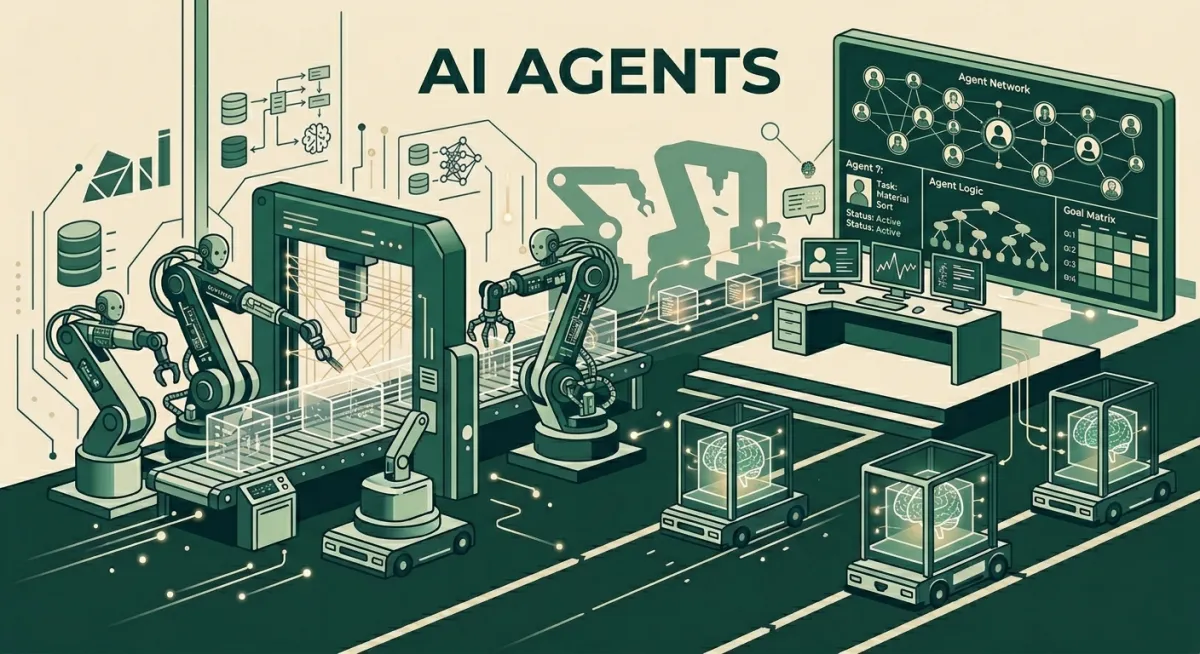
AI Agents for Business: The 2026 Deployment Guide
AI Agents for Business: Your First Hire That Never Clocks Out
An AI agent is an autonomous software system that perceives its environment, makes decisions, and executes multi-step tasks without requiring human prompting at each stage. Unlike a chatbot that follows a fixed script, an AI agent can reason, adapt to new inputs, and operate across multiple platforms—booking appointments in your CRM, sending follow-up messages via SMS, and updating your pipeline in real time, all while you sleep. For businesses in Austin, Houston, Silicon Valley, and the UK, this isn't science fiction; it's a deployable product in 2026.
Chatbot vs. AI Agent: The Distinction That Matters
The market is flooded with products using "AI agent" as a marketing label for what are actually rule-based chatbots. The distinction is architecturally significant and commercially important:
If your current "AI" solution can't take an action inside your CRM without a human reviewing it first, you have a chatbot—not an agent. The distinction matters because agents deliver compounding ROI through autonomous execution; chatbots deliver convenience at best.
What AI Agents Can Actually Do for Your Business Right Now
The following use cases are in production at businesses similar to yours—not in beta, not in pilot, not theoretical:
Sales & Lead Generation Agents
Qualify inbound leads via conversational AI across website chat, SMS, and Instagram DM.
Score prospects against your ideal customer profile and route hot leads to sales reps instantly.
Follow up with cold leads automatically over 30–90 day sequences without manual input.
Book discovery calls directly into rep calendars based on real-time availability.
Customer Service & Support Agents
Handle 60–80% of inbound support queries without human escalation.
Access CRM data to give personalized, account-specific responses.
Process refund requests, subscription changes, and status updates autonomously.
Escalate to human agents with full conversation context when needed.
Operations & Back-Office Agents
Automate invoice generation, payment reminders, and overdue account follow-up.
Monitor KPI dashboards and send daily/weekly performance summaries to leadership.
Process onboarding workflows for new clients—document collection, account setup, welcome sequences.
Coordinate scheduling across teams without manual back-and-forth.
The Architecture Behind a Production AI Agent
A business-grade AI agent is not a single tool—it's a system composed of several interconnected components. Understanding the architecture helps you evaluate vendor claims and make smarter deployment decisions:
LLM Core: The reasoning engine (GPT-4o, Claude Sonnet, Gemini) that processes inputs and generates intelligent responses.
Memory Layer: Short-term context (within a conversation) and long-term memory (user history, preferences, past interactions).
Tool Use / Function Calling: The ability to take actions in external systems—CRM updates, calendar bookings, API calls.
Orchestration Layer: The logic that determines which tools to use, in what sequence, based on the agent's goal.
Guardrails & Escalation: Defined boundaries on what the agent can and cannot do autonomously, with clear human handoff triggers.
GoHighLevel AI Agents: The Platform Doing the Heavy Lifting for SMBs
For businesses already using or considering GoHighLevel, the platform's native AI capabilities have matured significantly. GHL's Conversation AI can be configured to handle inbound lead conversations, qualify against custom criteria, book appointments, and push all data back into the CRM—without any third-party integration.
When augmented with custom connections to OpenAI or Claude, GHL becomes a surprisingly powerful agent deployment platform. Nervea's property agent client Santiago Acevedo is a direct example: his AI agents now book appointments and close clients around the clock, removing the need for human sales involvement at the top of the funnel entirely.
What Does It Cost to Deploy an AI Agent?
The honest answer depends on complexity, integration depth, and the platforms involved. Here's a realistic cost breakdown:
For context: a single full-time SDR in Austin or London costs $50,000–$80,000 per year in salary alone. An AI agent handling equivalent top-of-funnel qualification runs at $5,000–$12,000 annually—and operates 24/7 without PTO, sick days, or performance inconsistency.
The Risks—And How to Mitigate Them
AI agents introduce real operational risks if deployed without proper governance. Gartner predicts that over 40% of agentic AI projects will be cancelled by end of 2027—not because the technology fails, but because businesses deploy without adequate oversight frameworks.
Hallucination: LLMs can generate confident but incorrect responses. Constrain agent scope with clear system prompts and retrieval-augmented generation (RAG) for factual queries.
Data privacy: Agents handling customer conversations must comply with GDPR (UK/EU) and CCPA (California). Define data handling policies before deployment, use compliant platforms.
Runaway automation: An agent with too many permissions can take unintended actions. Implement approval gates for high-stakes actions like financial transactions or contract sends.
Poor handoff design: Customers stuck in unresolvable agent loops damage brand trust. Define escalation triggers clearly and test every edge case before going live.
How to Evaluate Whether Your Business Is Ready for AI Agents
Before deploying, run through this readiness checklist:
You have a defined, repeatable process the agent will execute (agents can't map undefined processes).
Your CRM is clean and up-to-date (agents are only as accurate as the data they access).
You have clear success metrics defined before launch (not just 'we want to save time').
Your team understands what the agent will and won't handle (manage internal expectations).
You have a human escalation path designed and tested (agents need supervisors, not babysitters).
The AI Agent Market in 2026: Numbers Worth Knowing
The AI agent market crossed $7.6 billion in 2025 and is projected to exceed $50 billion by 2030 at a 46.3% CAGR. Gartner forecasts that 40% of enterprise applications will embed task-specific AI agents by 2026. Early adopters are consistently reporting 20–30% faster workflow cycles and measurable cost reductions—particularly in back-office operations. The window for competitive differentiation through early agent adoption is open, but it won't stay open indefinitely.
Key Takeaway: An AI agent is not a feature—it's a business function. The businesses in Austin, Houston, Silicon Valley, and the UK that deploy well-architected agents in 2026 will have a structural operational advantage over competitors still running manual processes. The goal isn't to replace your team; it's to make sure your team is never doing work that a well-configured agent can handle better, faster, and cheaper.